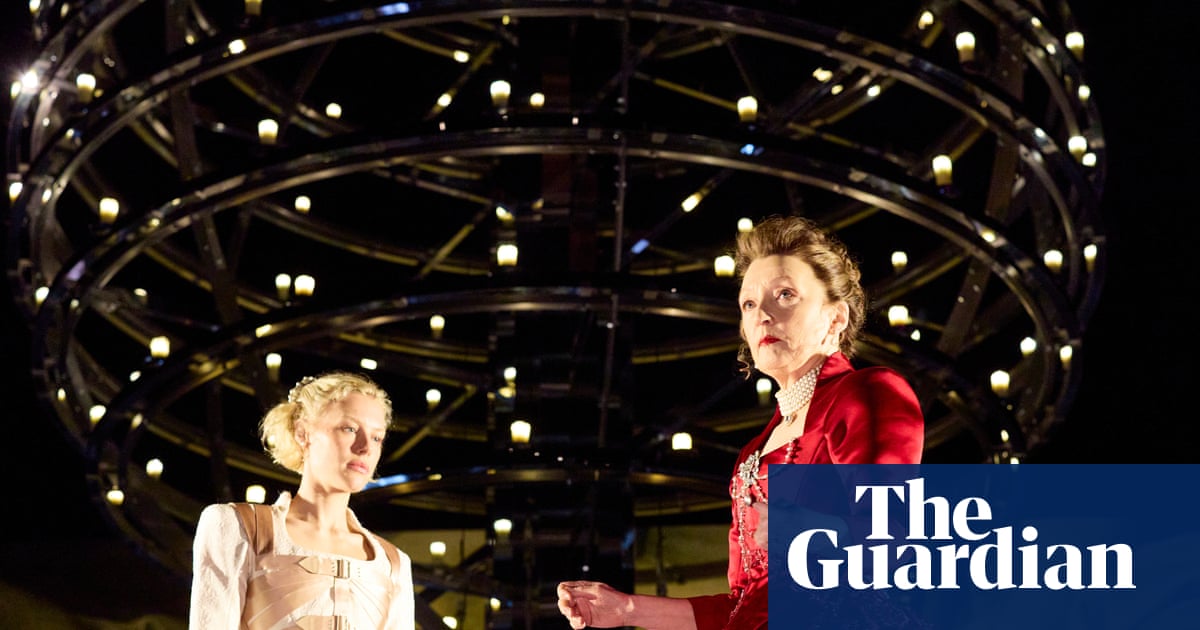

What goes into the creation of an enormous chandelier for a theatrical production, adorned with over 100 meticulously arranged, flickering candles? How about a dazzling disco floor that captivates the audience during the finale, although it remains hidden until that moment? On the brink of the 50th Olivier Awards, we delve into the talents of the artists, apprentices, engineers, and designers responsible for some of the most unforgettable theatrical experiences in London this year.
The striking mirrored chandelier that ominously hangs over Marianne Elliott’s rendition of Les Liaisons Dangereuses at the National Theatre is nothing short of extraordinary, even during technical rehearsals. Spanning nearly five meters in width, it accounts for over a third of the expansive Lyttelton stage. Suspended from above, it features 144 electric candles, each embellished with melted wax for a realistic touch, and required the expertise of around 40 of the National’s top artisans to come to fruition.
Janet Williamson, a senior construction draughtsperson at the National Theatre, explains, “The three engineers in our team all come from construction backgrounds. We possess the knowledge of how to assemble these components because we have experience in making them. The challenging aspect lies in translating your design into a format that everyone else can follow. The intricate details you focus on while designing on screen are often unknown to others. Precision is critical; a mere millimeter off can be noticeable.”
Kate John, the head of production workshops, remarked, “We’ve never tackled anything of this scale before. How do we even begin to engineer this?”
For Williamson, the journey of creating the chandelier—affectionately dubbed the “death star”—began with designer Rosanna Vize’s initial white card model of the set. The chandelier was immediately apparent as a major technical hurdle. “It was evident this would be a significant challenge,” she noted. Williamson collaborated with her colleagues in the National’s drawing room to brainstorm solutions.
Several crucial considerations emerged: the chandelier needed to disassemble into manageable sections for storage and maintenance, allowing it to be stack-built, while also ensuring access for the lighting crew to install all the necessary features. Drawing inspiration from unexpected sources, Williamson compared the chandelier’s design to a Terry’s Chocolate Orange, stating, “Many thought the chandelier should be sliced upwards, but that didn’t feel right. I decided it should be segmented like a Chocolate Orange. Each piece alone might seem unstable, but together they form a robust structure.”
In her search for effective design, Williamson also looked to the grand dome of Florence’s Duomo, which is similarly constructed from segments, confirming her approach as sound. “I knew I was on the right track,” she stated.
Williamson finds joy in the uniqueness of her work, saying, “Every project we undertake is a prototype; nothing like it has been done before.” The unpredictability of the job keeps her on her toes, especially with the chandelier project. She often finds herself asking, “Have I covered everything? Is everything correct?”
Les Liaisons Dangereuses is currently showcasing at the National Theatre in London until June 6.
In a different corner of London’s theatre scene, acclaimed designer Hildegard Bechtler found herself amidst the tranquil surroundings of Waterlow Park in Highgate, her mind still buzzing from the previous night’s rehearsals for Romeo & Juliet. Under the direction of Robert Icke, the production features actors Sadie Sink and Noah Jupe, with the contract signed only in November, leaving little time for conceptualization.
Bechtler shared, “The timeline for Romeo & Juliet was incredibly tight. Director Rob Icke and I were in New York working on Oedipus when this opportunity arose. My main concern was the limited time. There was immense pressure, as the contract was finalized late last year and we needed to finalize the design before Christmas. You can only move so quickly when collaborating with a director you’ve worked with extensively; there’s a shared understanding.”
Focused discussions quickly centered around one central piece: a bed. Initially, the design included several chairs, but it evolved into a flower-laden bed, which eventually was simplified into a stark yet powerful element that remained throughout the production. “We kept refining and refining, but the bed remained the focal point,” Bechtler explained.
The bed was designed to serve multiple purposes, acting as Juliet’s sleeping space as well as a cold, tomb-like structure. As rehearsals progressed, the idea emerged that the bed could remain on stage for various scenes, adding unexpected depth and resonance. The presence of the bed during fight sequences infused them with heightened energy, while iconic moments gained a dreamlike quality as Romeo entered from below, with Juliet positioned elegantly on her bed.