
Procurement, Power, and the Price of Failure
Inexperience, Fraud, or Corruption?
When the lights flicker in a country, the problem is rarely just technical.
It is systemic.
The controversy surrounding coal procurement for the Lakvijaya Power Station has now moved beyond routine criticism. It has entered the realm of national concern where governance, cost, and accountability intersect.
At its simplest, the issue appears straightforward:
Coal was procured. Questions were raised. An audit confirmed irregularities.
But in energy, simplicity is deceptive.
The Failure Point
The findings—partial, contested, but significant—suggest that procurement processes did not function as intended.
Whether due to oversight gaps, flawed specifications, or deviations in execution, the outcome remains the same:
suboptimal coal entered a system that depends on precision.
And when quality declines, costs rise.
Reduced efficiency at Norochcholai forces reliance on alternative generation—most notably diesel. This shift is not marginal. It is expensive.
And those costs do not disappear.
They transfer:
- To the grid
- To the balance sheet
- To the public
The Numbers Debate
Here lies the complication.
Official estimates place losses in the billions. Political narratives suggest figures far higher stretching into tens of billions.
The truth, as it often does, lies somewhere between what is confirmed and what is claimed.
But the exact number, while important, is not the central issue.
The system failed to prevent it.
The Governance Test
Coal procurement is neither new nor incomprehensibly complex. It is governed by established processes:
- Standards
- Sampling
- Verification
- Oversight
Which raises the uncomfortable question:
Was the system bypassed—or did it simply fail?
- If it was bypassed, accountability is direct.
- If it failed, accountability is structural.
Either way, responsibility cannot be indefinitely diffused.
The Energy Consequence
Sri Lanka’s energy security depends on reliability.
When a primary generation source is compromised—even partially—the ripple effects are immediate:
- Higher generation costs
- Tariff pressure
- Fiscal strain
This is not an isolated incident.
It is a systemic stress point.
The Verdict
The coal question is no longer about shipments.
It is about standards.
- Who approved?
- Who verified?
- Who is accountable?
Because in the end, the issue is not what was bought—
but whether the system designed to protect the country actually worked.
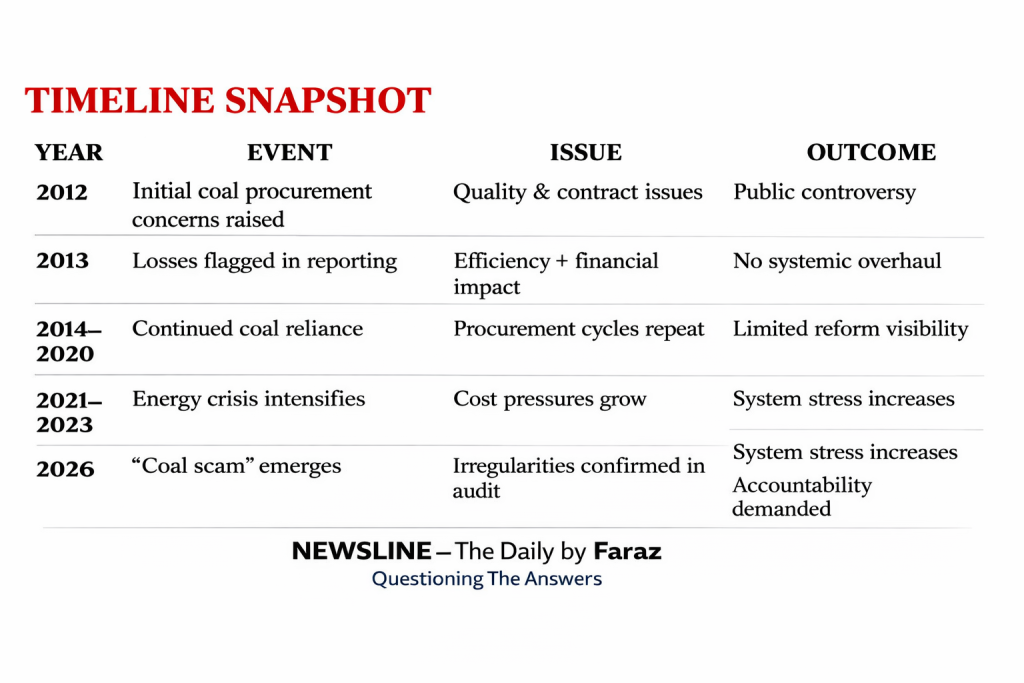
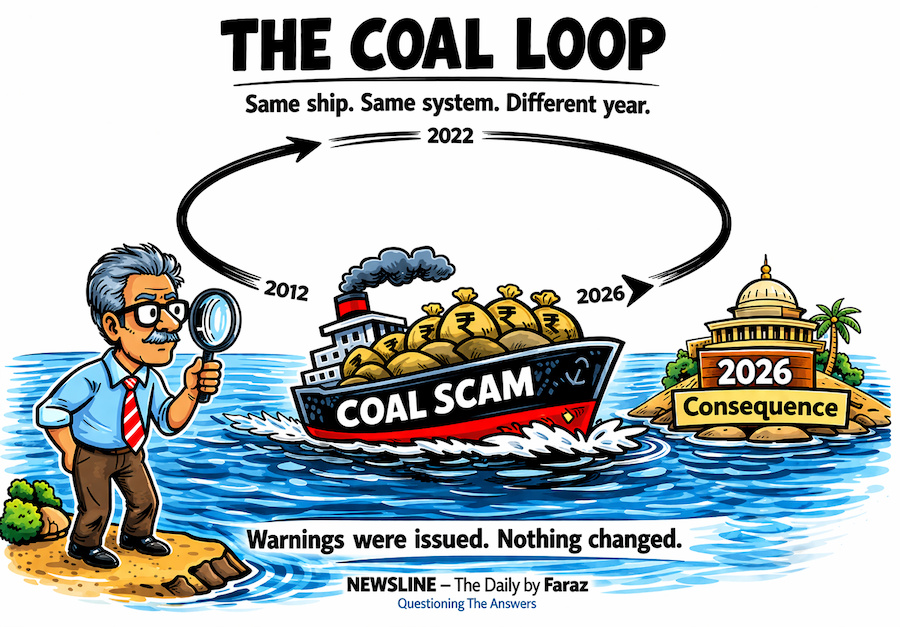
The Coal Story: Then vs Now
A decade apart—
the same fault lines remain.