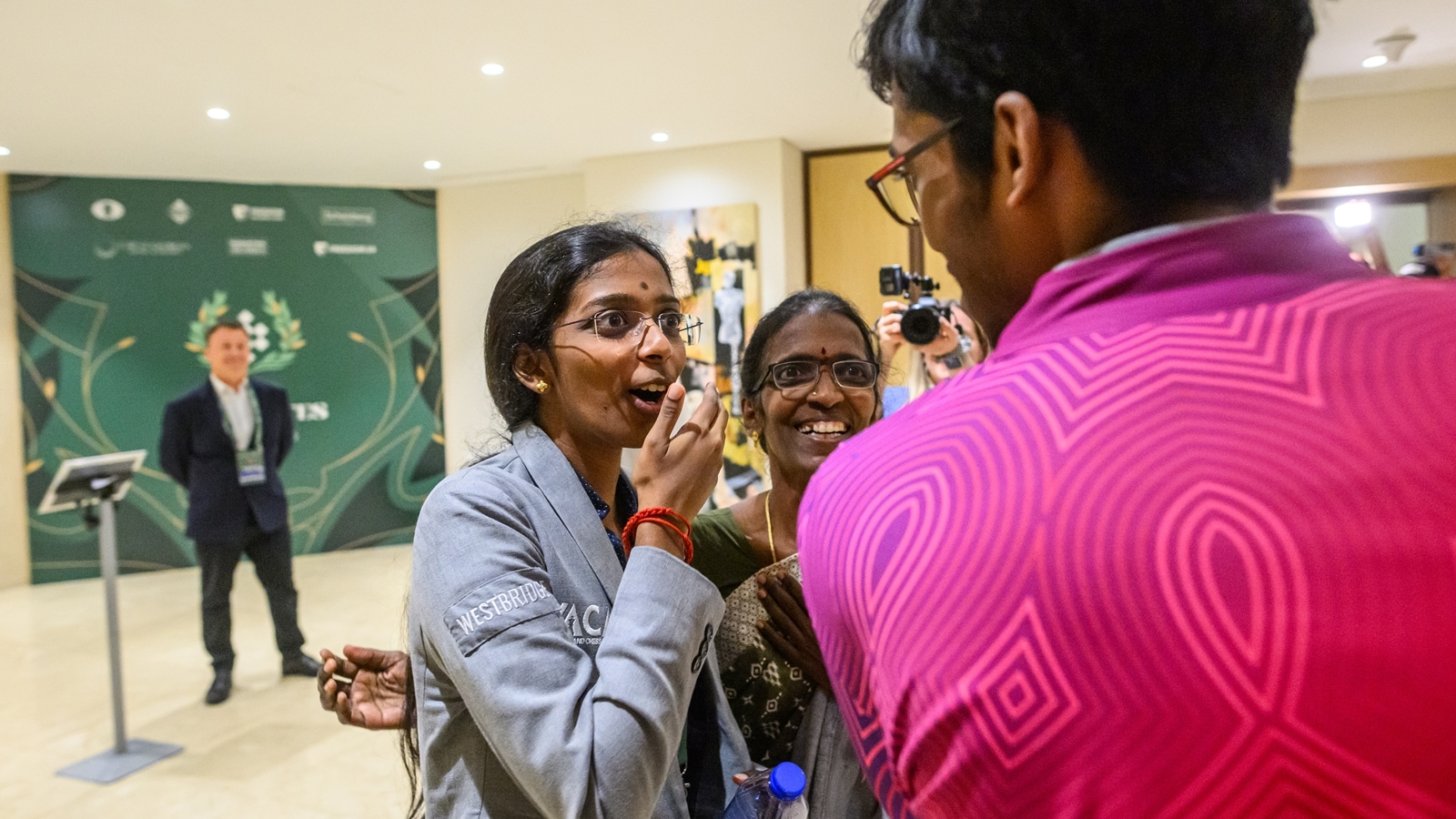

During Vaishali’s official crowning as the challenger to Ju Wenjun, her final match against Kateryna Lagno was highlighted by grandmaster Peter Svidler on the FIDE broadcast, who shared a story that emphasizes the unique qualities of the 24-year-old player. Svidler, who has recently coached her brother, R Praggnanandhaa, recalled a moment when Vaishali attended one of his coaching sessions. Her presence left a profound impact on the attendees.
In that session, one of the coaches presented a particularly intricate chess position, described by Svidler as “very, very difficult.” The complexity of the scenario led to a flurry of discussions, suggestions, and strategies as everyone sought a solution.
Vaishali, however, remained silent. For an entire hour, she focused intently, calculating the position in her mind while the others around her proposed incorrect solutions. Eventually, she arrived at the answer. While Svidler noted that she may not have resolved every final move, her understanding was clear and decisive.
What struck Svidler was not just her ability to find the solution but the patience it required. He remarked, “I don’t possess that capability. It’s completely foreign to me to simply sit and calculate until the answer emerges.”
Conversations with various people about Vaishali reveal many dimensions of her gameplay, yet one characteristic consistently stands out: her remarkable ability to remain calm and persistently work through challenges until they are resolved.
Years prior to impressing Svidler, renowned coach S Thyagarajan recognized this same trait in a seven-year-old Vaishali at Chennai’s Bloom Chess Academy, which she attended partly to distance herself from cartoons. Unlike her lively peers, she exhibited an unusual stillness for her age, akin to a young monk.
“She could remain focused for hours at a time, which was quite extraordinary. Even at seven, she could maintain her concentration for five or more hours at the chessboard, a rarity for children that age,” he recalled.
These early experiences not only instilled discipline in Vaishali but also laid the groundwork for her gameplay, including the aggressive style that would later define her approach. At the Candidates tournament, she made headlines by sacrificing both of her rooks in a daring move against Divya Deshmukh, showcasing her aggressive flair that can shift the dynamics of a game and earn her admiration from peers, including her brother.
Praggnanandhaa later confessed that he wishes he had more of Vaishali’s attacking instinct. While her patience appears innate, her aggression was cultivated early on, and her calculation skills were honed under the guidance of R B Ramesh at Chess Gurukul.
Ramesh’s training methods were rigorous. He would set up a position and then remove the pieces, compelling students to rely solely on visualization to calculate moves. Even when deep into a game, they had to navigate without any physical reference, relying on mental acuity alone.
“We would be beyond move 15 while the pieces stayed in their original positions on the board,” Praggnanandhaa explained. “It was not just a matter of visualization but also about identifying strong moves.”
These exercises come into play during critical moments in competition when the complexity of positions necessitates precise calculation.
The training regimen was demanding, involving a one-and-a-half-hour commute to Chess Gurukul on their father’s motorcycle, regardless of weather conditions, followed by four consecutive hours of training.
While other children took breaks, Vaishali and Praggnanandhaa remained engaged, often playing blitz games continuously. “From the beginning, they would travel about one and a half hours daily to reach my academy, no matter what,” Ramesh recounted. “After four hours of intense chess, while others took breaks, they opted to play blitz.”
What stood out was their insatiable desire for the game; they never appeared fatigued.
When five-time world champion Viswanathan Anand established the Westbridge Anand Chess Academy following the pandemic, Vaishali was the only female talent selected from a group of India’s most promising players.
Over time, Anand recognized the attributes that distinguished her: her tactical acuity, her calculation skills, and her capacity to endure under pressure — all qualities that help her maintain composure and discover resources in challenging situations.
However, in the past two years, her journey has been fraught with challenges. Results have been inconsistent, and her ratings have declined. Entering the Candidates tournament as the lowest-rated player in the competition, she continued her unwavering dedication without a dramatic overhaul — just the same habits of patience, calculation, and hard work.
Ultimately, her efforts bore fruit. She not only participated in the Candidates tournament but emerged victorious.
A young girl who, at the age of seven, could sit in silence for hours to find answers has carried that same sense of calm throughout her journey, leading her to this significant achievement.
Amit Kamath serves as the Assistant Editor at The Indian Express, based in Mumbai. He focuses on chess and Olympic sports and co-hosts the Game Time podcast, a weekly segment from Express Sports. Additionally, he writes a weekly chess column titled On The Moves.