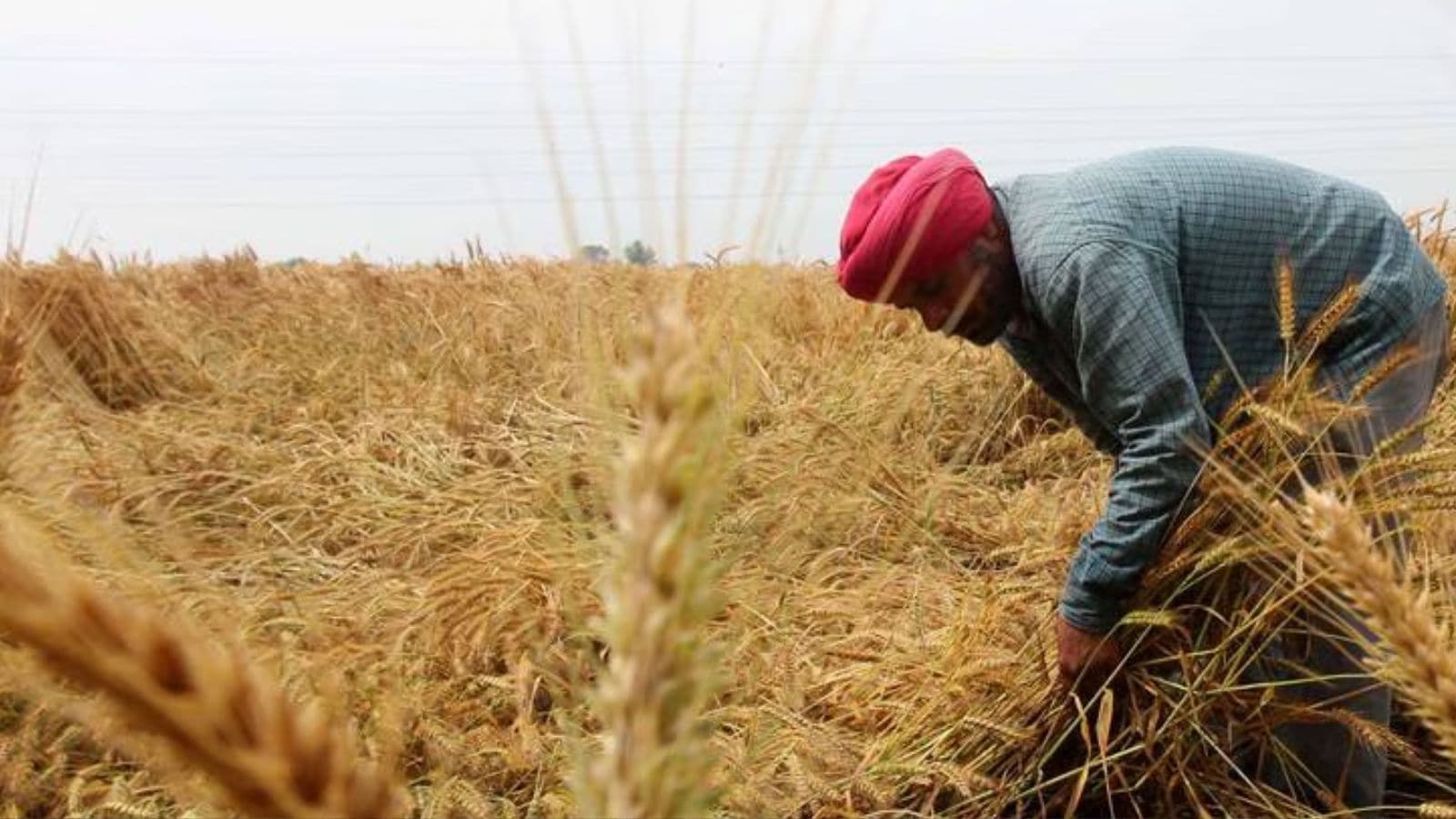

Unusual and heavy rainfall during the initial week of April has resulted in a notable increase in precipitation levels across Punjab and Haryana, raising concerns regarding the wheat crops that are approaching harvest time.
Official reports indicate that Punjab experienced an average rainfall of 21.7 mm during the week, significantly higher than the normal 3.8 mm, leading to an extraordinary 471% increase in precipitation from April 3 to April 9. In a similar trend, Haryana recorded 11.1 mm of rainfall compared to its usual 2.9 mm, marking a 281% surplus for the same time frame.
Within Punjab, several districts reported remarkably high rainfall figures. Fazilka reported the highest at 50.8 mm, an astonishing 2018% above normal, followed closely by Moga with 40 mm (1639% excess) and Mohali at 31.4 mm (1208% excess). Sangrur (53 mm, 742% excess) and Barnala (22.8 mm, 743% excess) also recorded significant rainfall. These statistics suggest that this April has seen one of the most intense rain periods in recent years.
Conversely, some districts experienced relatively lower amounts of rainfall. Hoshiarpur recorded 4.4 mm, slightly below the normal average (-9%), while Ludhiana (8.7 mm, 108% excess) and Jalandhar (13.2 mm, 170% excess) received moderate precipitation, still above their normal levels.
In Haryana, Chandigarh saw the highest rainfall at 47.4 mm, a remarkable 1430% above normal, followed by Kurukshetra (35.9 mm, 1279% excess) and Gurgaon (16.8 mm, 949% excess). Other areas, including Mahendragarh (17.1 mm, 972% excess) and Kaithal (1.1 mm, 770% excess), also experienced substantial rainfall.
On the other hand, districts like Sonipat recorded a shortfall (-35%) in rainfall, while Ambala saw a decrease of 13%. Areas such as Rohtak (4.4 mm, 37% excess) and Bhiwani (3.9 mm, 22% excess) received lighter showers compared to others.
The widespread rain, combined with strong winds and sporadic hailstorms, has directly affected the wheat crops in both states. Agricultural specialists have noted instances of crop lodging, where the plants bend or fall due to adverse weather, in several Punjab districts such as Moga, Fazilka, and Sangrur, as well as parts of Haryana.
Farmers are apprehensive that the excess moisture at this critical growth stage may adversely impact grain quality, potentially leading to increased moisture content, discoloration, and decreased market value. Additionally, waterlogging in lower-lying fields has worsened the situation, particularly in areas that experienced heavy rainfall.
As the harvest season approaches, these unexpected rains have underscored the susceptibility of wheat crops to fluctuating weather conditions. Authorities are actively monitoring the developments, while farmers remain worried about possible declines in yield and quality.
Following the recent rainfall, weather forecasts indicate a return to dry conditions in the coming days, with a significant rise in temperatures anticipated.
According to meteorological reports, a western disturbance currently exists over Jammu and nearby regions, creating a cyclonic circulation that affects higher altitude weather. Another new western disturbance is also present in the mid-level westerlies, although its direct impact on the plains is expected to be minimal.
An upper-air cyclonic circulation continues to linger over northwest Uttar Pradesh and adjoining Uttarakhand, while powerful subtropical westerly jet streams, with wind speeds up to 130 knots, dominate the weather patterns over northwest India.
Despite these weather systems, the region is expected to experience dry conditions for the next week, providing respite after the recent unseasonal rainfall.
Meteorological experts have forecast a notable increase in maximum temperatures by 6–8°C over the next five days, which could hasten the ripening of the wheat crops and facilitate harvesting efforts.
However, another western disturbance is anticipated to impact the Western Himalayan region from April 15, potentially altering weather conditions once again.
For the latest updates, follow us on Instagram.