
Recent polling conducted by the New South Wales Office for Youth has revealed that approximately 70% of young individuals in the state regularly utilize artificial intelligence (AI) in both their educational pursuits and personal lives.
Among those championing the integration of this technology in academic settings is Hafsa Faizan, a student from Sydney. Nevertheless, there are ongoing concerns regarding the effects of AI on critical thinking abilities, environmental issues, and future job prospects.
While many young people engage with AI for leisure activities such as planning vacations or creating humorous content, Hafsa, a 14-year-old from Austral in Sydney’s southwestern region, employs AI to enhance her debating skills. She began her high school journey just as AI-driven chatbots were becoming prevalent in popular culture.
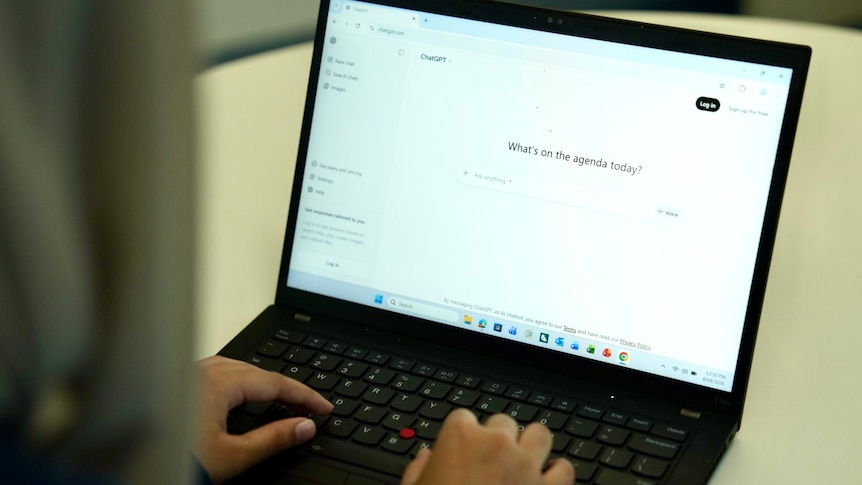
Despite her school’s restrictions on accessing platforms like ChatGPT, Hafsa has found that AI significantly enhances her learning experience at home. “I primarily use it to make my studying more interactive rather than passive,” she explained. “Instead of merely reading notes, I transform them into flashcards and quizzes, which helps me retain information more effectively.”
Hafsa also seeks AI’s assistance for feedback on her assignments, enabling her to refine her arguments. “After completing an assignment, I present it to AI for suggestions on improvements,” she noted.
Outside her academic endeavors, Hafsa incorporates AI into her hobbies. “I participate in numerous debating competitions, and recently I’ve had AI generate topics along with corresponding arguments and rebuttals to prepare for them,” she shared. “I find it beneficial for developing skills and acquiring new knowledge.”
The integration of AI in education appears widespread, with the NSW Office of Youth’s survey indicating that 70% of the 2,300 respondents have utilized AI tools over the past year. Many participants expressed that AI positively influenced their lives by providing academic support, enhancing productivity, and fostering creativity and idea generation.
However, some respondents voiced concerns about potential over-reliance on AI and its implications for employment opportunities and the environment. Katherine McKernan, the NSW Advocate for Children and Young People, emphasized that both the government and the education sector have responsibilities in addressing these issues. “Young people are at the forefront of adopting and leveraging AI’s potential; our challenge is to keep pace with the support and regulatory frameworks we provide,” she stated.
Additionally, the research indicated that one in four young participants sought advice and mental health support from AI chatbots, prompting Ms. McKernan to highlight the need for vigilance in this area. “We must be cautious about how young people engage with AI, ensuring they use it safely and effectively for their well-being,” she remarked.
The Department of Education is in the process of creating an EduChat AI tool intended for use in schools, which Ms. McKernan views as a promising initiative for promoting safe and educational AI engagement.
Hafsa has also shared her insights on AI’s role in education through a TEDx Talk, receiving a range of responses. “I’ve encountered individuals with differing opinions, which is entirely valid, as there are legitimate concerns to address,” she commented. “The restriction of AI access in schools is not the solution; we should focus on how to utilize it to our advantage.”
She believes that while AI cannot replace teachers, it can function as a valuable supplementary tool. “A single teacher cannot adequately cater to the needs of 30 students individually,” she remarked. “While they can provide essential information, AI can better address the unique strengths and weaknesses of each student.”
Looking ahead, Hafsa is optimistic about the integration of AI into the workforce. “I acknowledge that AI may replace certain repetitive jobs, but this is a pattern we’ve observed with various technological advancements,” she explained. “However, AI cannot replicate human creativity and critical thinking, which will remain essential skills in the future.”