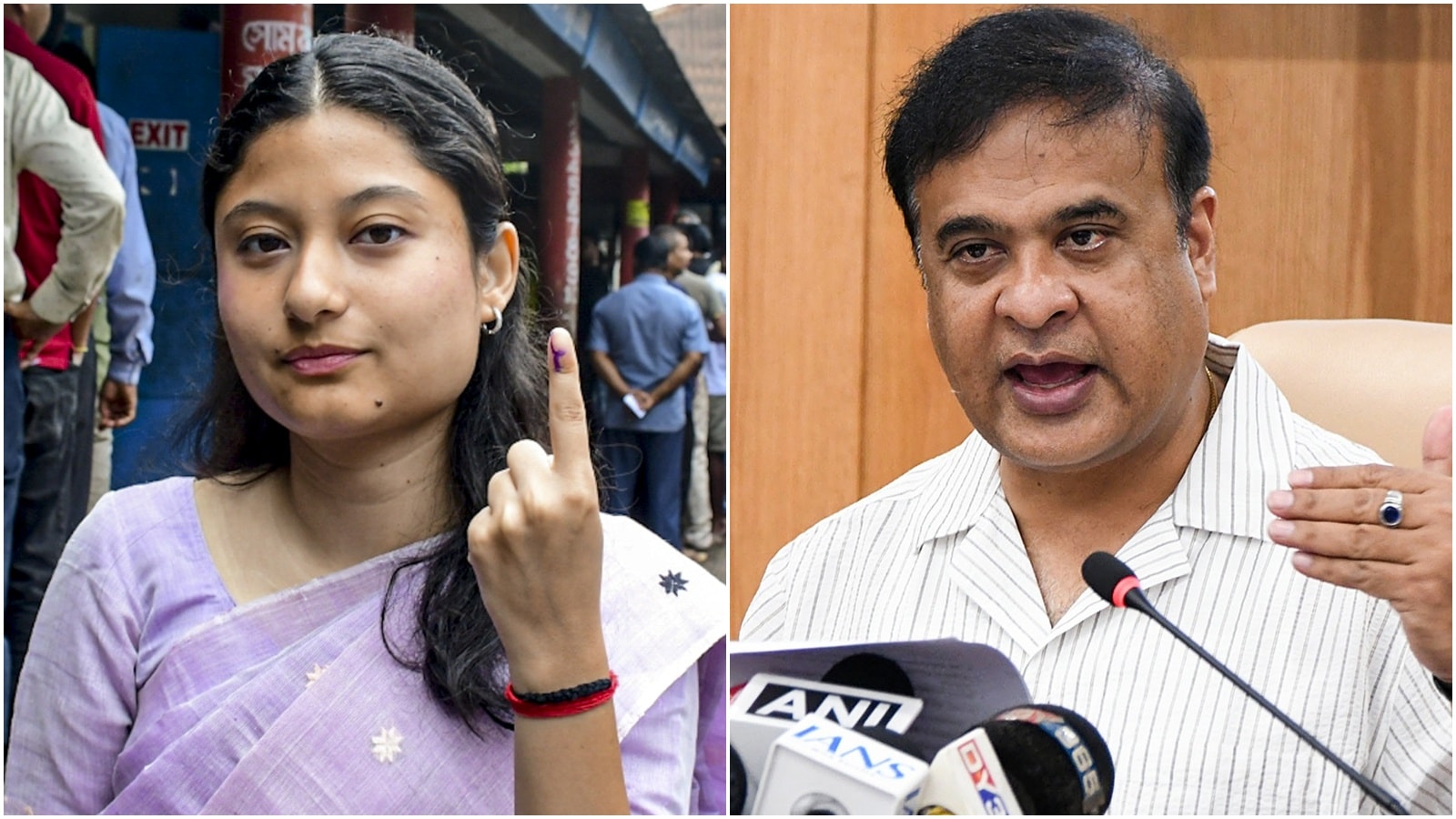

Sujata Gurung Chowdhury, the mother of Kunki Chowdhury, a candidate in the Assam Assembly elections, has formally reached out to the National Commission for Women (NCW) regarding alleged “false, defamatory and misleading statements” made about her by Chief Minister Himanta Biswa Sarma. She claims these remarks have resulted in her experiencing online harassment.
During his campaign leading up to the election on April 9, Sarma repeatedly targeted Kunki Chowdhury, representing the Assam Jatiya Parishad in Central Guwahati, who is notably the youngest contender in the elections, as well as her family. One of his main accusations was that Sujata Gurung Chowdhury had shared “photos of eating beef” on social media. He also criticized her, indicating that she “openly supports” controversial figures such as Umar Khalid and Sharjeel Imam, particularly noting her critical stance towards him on social media.
On Monday, Sujata filed an online complaint with the NCW, requesting “urgent intervention” concerning the allegations made against her.
In her complaint, she emphasized her status as a private individual with no active role in electoral politics, asserting that her involvement in public discussions stemmed solely from her daughter’s candidacy in the Assam Assembly elections. She contended that the allegations made by Chief Minister Sarma—including claims that her social media presence has “hurt the sentiments of Sanatani people,” that she “harbors sympathy for Pakistan,” and that she supports “anti-national individuals”—are unfounded, defamatory, and aimed at damaging her reputation while politically targeting her daughter.
Sujata also clarified that a photograph presented by Sarma, purportedly showing her “eating beef,” was actually an image of her holding a conical pillow at the International Church of Cannabis in Colorado, USA.
She further reported that the allegations have led to the unauthorized circulation of her personal photographs, including images with her minor son, on social media, resulting in her being “subjected to online abuse, harassment, and character assassination.”
“Various unidentified individuals and social media accounts have disseminated manipulated images and AI-generated content to tarnish my dignity,” she stated in her complaint.
In her request, she has sought an investigation into the “defamatory statements and online harassment,” the removal of harmful and manipulated content from social media, recommendations for legal action against Sarma for inciting such behavior through his “fake propaganda and malicious intent,” as well as measures to protect her dignity and her minor child’s privacy.
“I submitted the complaint online and have received a standard acknowledgment from the NCW,” she informed The Indian Express.
However, she refrained from commenting on a separate case filed against Kunki and her campaign team in Guwahati, which alleges a breach of the Model Code of Conduct. Kunki was interrogated by police on Sunday, and she has denied the allegations, with her party, the AJP, condemning the case as a form of “politics of intimidation.”
Sukrita Baruah serves as a Principal Correspondent for The Indian Express in Guwahati, where she delivers in-depth coverage of India’s Northeastern region, known for its intricate ethnic diversity, geopolitical importance, and unique developmental issues.
Her areas of expertise include:
- Ethnic & Social Dynamics: In-depth analysis of regional conflicts and peace initiatives.
- Border & Geopolitics: Monitoring developments along India’s borders and their effects on local populations.
- Governance & Policy: Reporting on state elections, tribal council activities, and the execution of central schemes in the Northeast.
Prior to her current position, Sukrita was an Education Correspondent for The Indian Express in Delhi, equipping her with a keen analytical perspective on:
- Policy Analysis: Scrutinizing the National Education Policy and reforms in higher education.
- Student Affairs: Covering significant issues related to campus politics, national entrance exams, and challenges in primary and secondary education.