
Each time you rely on Google Maps for directions or utilize GPS to share your location, you are indirectly engaging with Albert Einstein’s two theories of relativity.
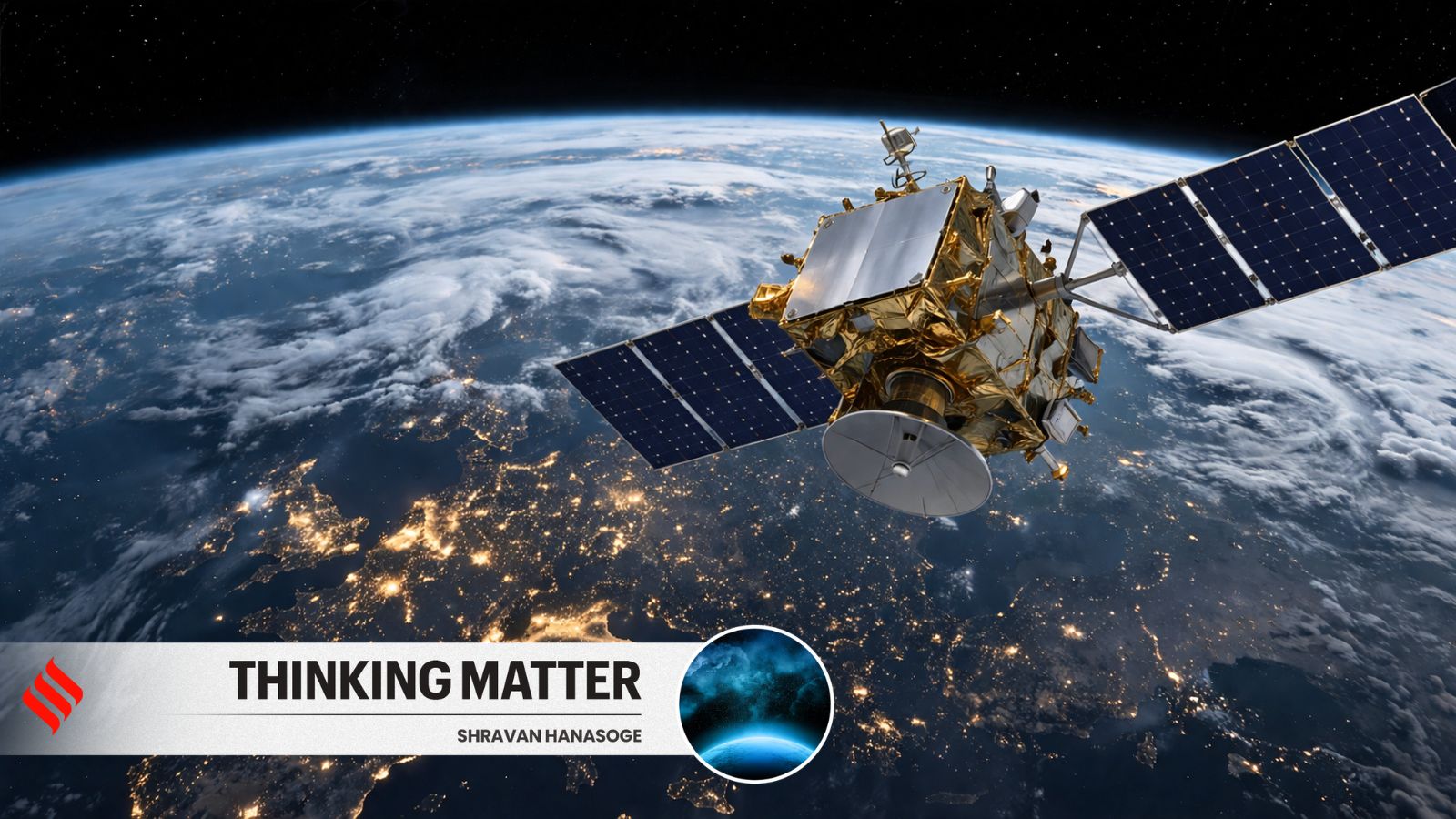
This connection arises from the Global Positioning System (GPS), which operates using satellites that circle the Earth at an altitude of approximately 20,000 kilometers while traveling at remarkable speeds. The timekeeping mechanisms on these satellites do not operate in sync with those on the ground due to relativistic effects.
The basis for this phenomenon can be traced back to two pivotal theories introduced by Einstein: the Special Theory of Relativity in 1905 and the General Theory of Relativity in 1915, which have opposing effects on time measurement.
According to Special Relativity, the high velocities of the satellites—exceeding 14,000 kilometers per hour—result in their clocks running approximately 7 microseconds slower each day. Conversely, General Relativity indicates that the reduced gravitational pull at their altitude causes the satellite clocks to tick faster by about 45 microseconds daily. The overall outcome is that satellite clocks advance roughly 38 microseconds each day compared to those on Earth.
While this discrepancy may seem minimal, failing to adjust for it would cause GPS readings to deviate by several kilometers within just one day. Hence, the effectiveness of modern navigation systems hinges on the varying nature of time, influenced by both motion and gravitational forces, precisely as Einstein anticipated.
Einstein, a young patent examiner in Bern, Switzerland, published his groundbreaking work on special relativity in 1905, transforming our understanding of space and time. Although it may initially appear counterintuitive, the theory posits that time can slow down, distances can contract, and observers in relative motion might disagree on the simultaneity of events.
Over a century later, every prediction stemming from this theory has been validated, reinforcing its status not merely as a theoretical concept but as a robust description of the universe’s functioning. At the core of special relativity lies a deceptively straightforward principle: the speed of light remains constant. Regardless of your velocity, light travels at approximately 300,000 kilometers per second, challenging conventional intuitions about how speeds combine. For example, if you toss a ball forward on a moving train, an observer on the ground perceives the ball’s motion as faster than you do on the train. However, light defies this logic, prompting Einstein to explore the implications of a constant light speed on our understanding of time and space.
This exploration led to the revolutionary insight that both space and time are not fixed entities but rather dynamic constructs that adapt to ensure the constancy of light speed. As Einstein famously expressed, “The distinction between the past, present and future is only a stubbornly persistent illusion.”
One of the most notable implications of special relativity is time dilation—the concept that moving clocks operate at a slower rate. In an experiment conducted in 1971, physicists Joseph Hafele and Richard Keating flew atomic clocks around the globe on commercial flights. Upon their return, these clocks were out of sync with identical stationary clocks on the ground, corroborating Einstein’s theory, albeit with minute differences measurable in billionths of a second.
This evidence confirmed that time indeed passes at different rates based on relative motion, a fact that is critical for the functionality of GPS satellites. Without considering these relativistic effects, navigation systems would experience significant inaccuracies daily.
Furthermore, special relativity introduced one of the most iconic equations in physics: E = mc², which elucidates the interchangeability of mass and energy. This relationship reveals that even a small quantity of mass contains an immense amount of energy, given it is multiplied by the square of the speed of light. This principle is foundational to both nuclear energy and weapons, as well as the processes powering the Sun through nuclear fusion.
As physicist Richard Feynman noted, “It is important to realize that in physics today, we have no knowledge of what energy is.” Relativity transcends mere equations; it fundamentally transforms our comprehension of essential concepts such as energy.
In 1915, Einstein expanded upon his earlier work with the General Theory of Relativity, offering a new perspective on gravity. Rather than viewing gravity as a force acting across distances, it is understood as the curvature of spacetime caused by massive objects. To visualize this, one might imagine spacetime as a stretched fabric, with celestial bodies represented as tennis balls placed upon it.
A remarkable implication of this theory is that gravity influences the flow of time. Clocks situated in stronger gravitational fields will tick more slowly than those in weaker fields. Therefore, a clock on Earth will run marginally slower than one aboard a satellite in orbit. Although the difference is minimal—measured in microseconds—it is both real and quantifiable.
In summary, Einstein’s two theories weave a compelling narrative. Special relativity illustrates how motion alters time, while general relativity demonstrates that gravity exerts a similar effect, warping spacetime and subtly influencing the ticking of clocks. The same principles that govern black holes and the universe’s expansion also apply to the satellites orbiting our planet, ensuring that their timekeeping remains precise for accurate mapping.
What began as an abstract inquiry into the nature of light has evolved into a comprehensive framework for understanding everything from cosmic phenomena to our everyday travels. Each time we utilize GPS for navigation, we are not merely charting our path on Earth; we are, in a subtle yet significant manner, navigating the universe as described by Einstein.
Dr. Shravan Hanasoge serves as an astrophysicist at the Tata Institute of Fundamental Research in Mumbai.