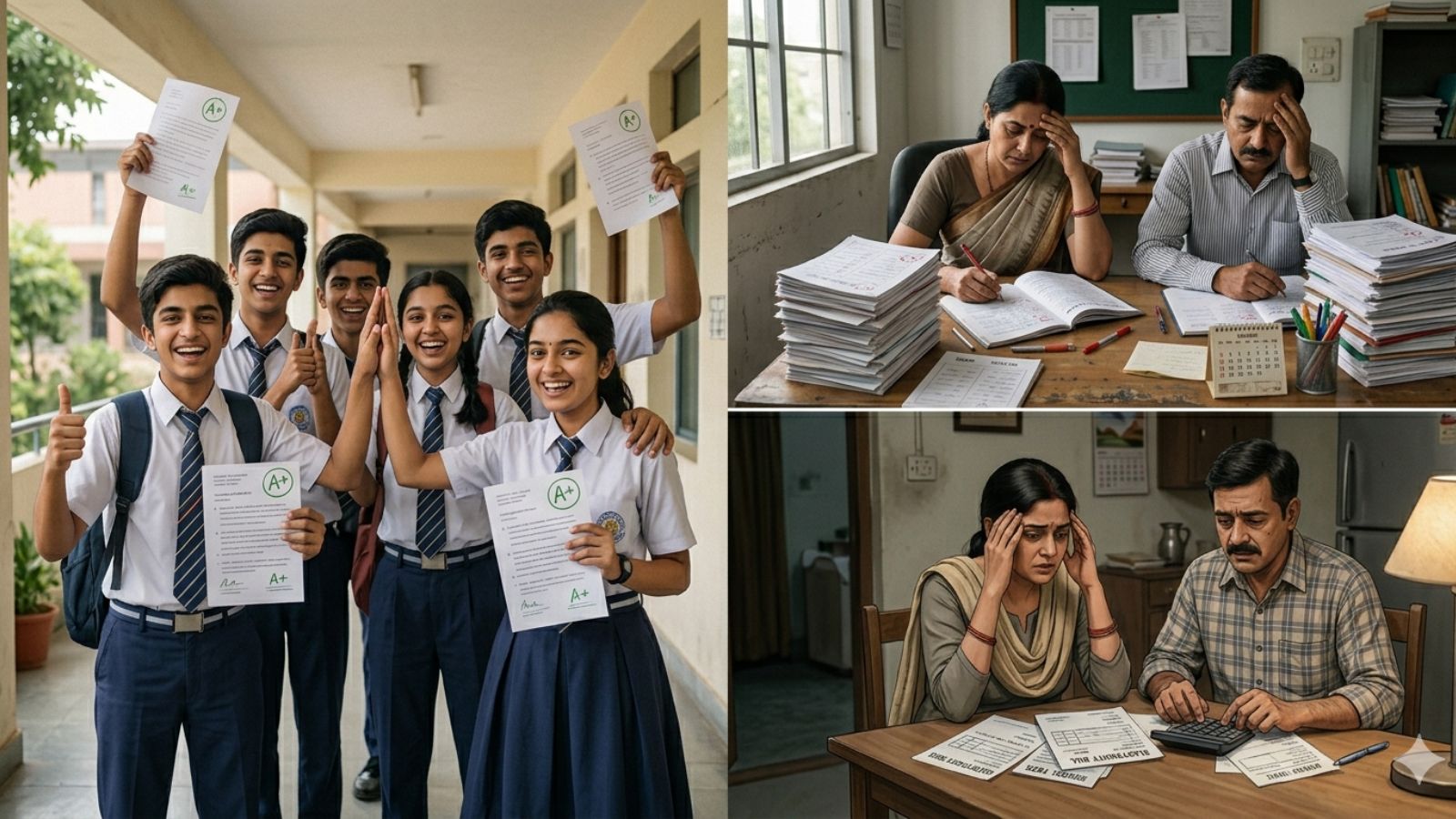

For many years, a standardized set of board examinations has shaped the educational paths of millions of Class 10 students throughout India, with extensive preparation culminating in a single critical outcome. This traditional model is now experiencing a noteworthy transformation, as the Central Board of Secondary Education (CBSE) implements a new policy allowing for Class 10 board exams to be held twice a year. The inaugural results are anticipated in April, while the subsequent exam is scheduled for May, with the final marksheet reflecting the highest score obtained by the students.
Despite the syllabus, exam format, and assessment criteria remaining consistent, the introduction of the optional second attempt has ignited discussions and debates since its announcement last year. Nearly 18-20 lakh students register annually for the CBSE Class 10 board exams, prompting parents and educators to ponder whether this change creates a fairer examination environment or contributes to increased academic pressure by extending the exam cycle. Additionally, concerns have been raised regarding the implications for school schedules, teaching timelines, and logistical preparations.
To gain insights into how this reform is being perceived beyond formal communications, indianexpress.com engaged with various stakeholders to capture a grassroots perspective on what is considered one of the most significant alterations to India’s board examination framework in recent times.
At Modern English School in Kahilipara, Guwahati, Principal Jonali Das candidly expresses her views on the added challenges facing CBSE educators. She indicates that while the teaching pace has not drastically changed—schools typically complete their core syllabus before the pre-board exams in November—the new structure has intensified the cumulative pressure on teachers, who now must manage two examination periods alongside Class 12’s on-screen evaluation and compressed assessment intervals.
“In the absence of ongoing training, adequate infrastructure, realistic timelines, and balanced workloads, these reforms could lead to teacher burnout and a focus on compliance rather than effective teaching,” she warns. “With the evaluation for the February exam occurring in March-April and the second exam commencing in May, when do teachers actually find time to rest?” she questions.
Ganesh Sharma, Principal of the Global Indian International School in Noida, believes that this change will gradually foster a positive shift in classroom dynamics. “When students are aware that they have an additional chance to enhance their performance, the intense stress associated with a single, high-stakes exam is alleviated. This also promotes a more continuous learning approach in classrooms, allowing students to reflect on their initial performance and focus on areas needing improvement, with teachers providing targeted academic support,” Sharma elaborates, noting that this aligns with the broader movement towards competency-based education.
This initiative, rooted in the National Education Policy (NEP) 2020 and implemented through the National Curriculum Framework, is being framed by the board as a significant departure from the ‘single final exam’ paradigm. Following CBSE’s lead, state education boards in regions like Madhya Pradesh and Haryana are set to adopt similar changes in the current or upcoming academic year.
In India, educators typically enjoy a summer break ranging from four to six weeks, usually commencing in mid-May and concluding in late June or early July, although the specific schedule can vary by state and local conditions. However, this time off may be curtailed for teachers who will be engaged in various responsibilities such as supervising exams, grading papers, preparing question sets, and addressing inquiries from students preparing for the second attempt.
Das’s concerns resonate with many educators nationwide, who fear that the dual-exam format, coupled with other ongoing reforms, might fragment the academic calendar to such an extent that meaningful instruction is sacrificed in favor of relentless exam management, thereby increasing the burden on teachers.
Moreover, teachers often serve as booth-level officers, updating electoral rolls and finalizing lists of eligible voters during the Special Intensive Revision (SIR) period. While this task primarily involves government school teachers, it places additional demands on their time and could potentially impact the education of students in those schools.
Conversely, Sharma suggests that it is premature to assume that summer breaks will vanish entirely. “The second examination is optional and mainly designed for improvement, so not every student will take it. If evaluation timelines are organized efficiently, schools can still provide teachers with a reasonable break. While the reform does increase academic responsibilities, a thoughtful approach to scheduling and administrative support can help maintain a balance between examination duties and teachers’ well-being,” he argues.
Nonetheless, he concurs that teachers will be occupied with evaluation tasks and examination-related responsibilities for an extended duration, especially since the CBSE mandates that schools release teachers for grading and related processes to ensure prompt results.
M A Anitha, vice-principal of the JAIN International Residential School (JIRS) in Bengaluru, suggests that while the traditional summer break may not entirely disappear, it is likely to undergo significant changes. “The concerns regarding the potential loss of the conventional summer break are legitimate. With evaluations for the February exam extending into March and April, closely followed by the second examination cycle in May, the academic calendar becomes more compact,” she states, advocating for a staggered or rotational rest system for educators to avert burnout. She emphasizes the need for systematic planning rather than a reactive approach to these challenges.