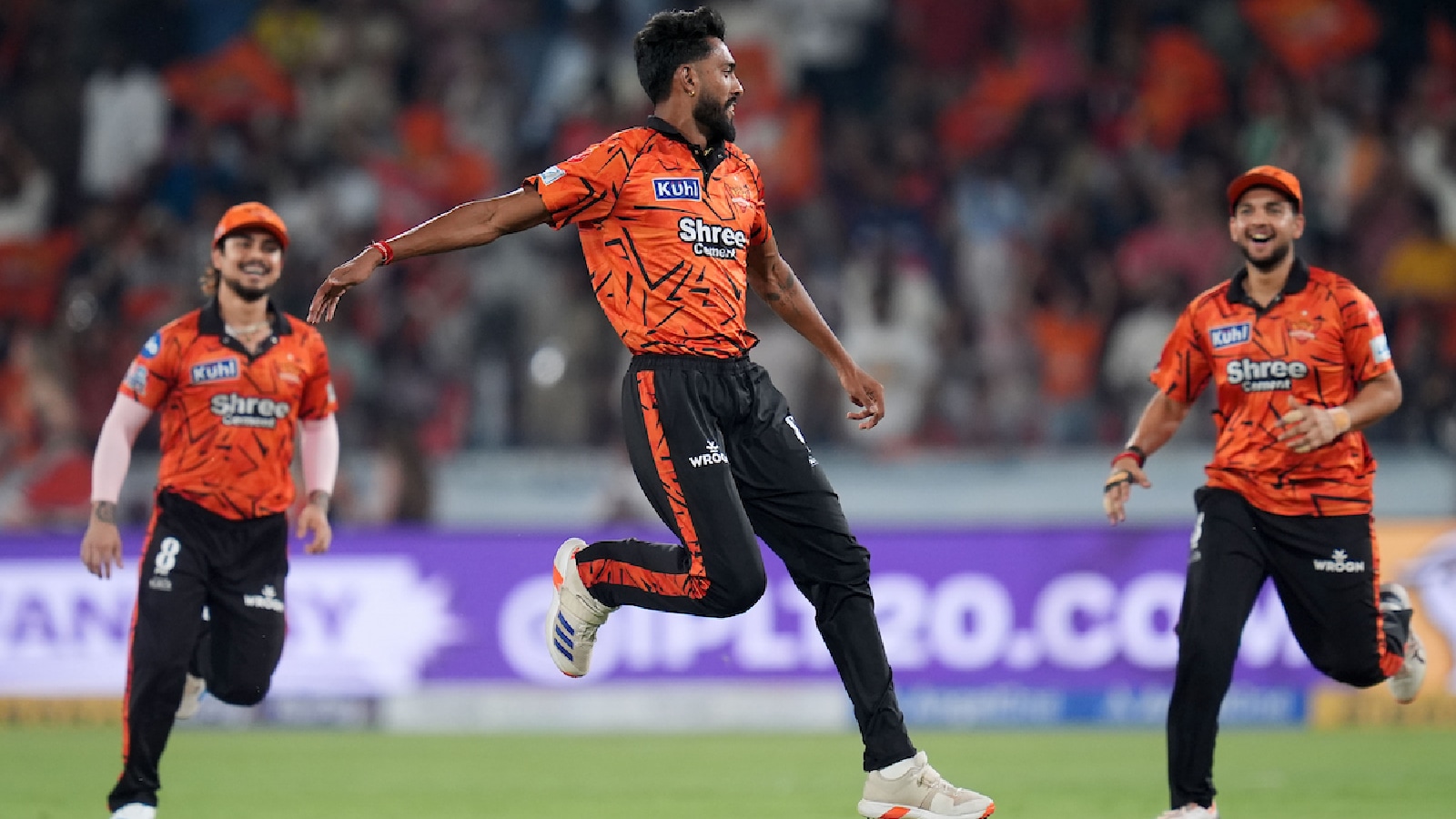

Kavya Maran sprang to her feet even before the ball was secured. As Praful Hinge’s delivery ricocheted off Vaibhav Sooryavanshi’s bat into the night sky above Hyderabad, the owner of Sunrisers Hyderabad was already in a posture of prayer.
As the ball descended, wicketkeeper Salil Arora positioned himself perfectly, caught it, and an eruption of celebration ensued in the SRH dugout as they leaped in jubilation.
Sooryavanshi glanced skyward, departing the field without scoring. The 15-year-old, who had been impressively striking boundaries against seasoned bowlers like Jasprit Bumrah and Josh Hazlewood throughout the tournament, fell victim to an unknown debutant.
Next came Dhruv Jurel, who was dismissed on the second ball he faced. Lhuan-dre Pretorius stepped in next, and on the sixth ball of the over, was caught at deep backward square leg. This marked a historic moment, as three wickets fell during a single over for the first time in IPL history, leaving Rajasthan Royals at a dismal 1/3 before the second over had even begun.
Vaibhav Sooryavanshi ✅
Praful Hinge ✅
Lhuan-dre Pretorius ✅
A remarkable initiation for Praful Hinge on his #TATAIPL debut 🧡
Meanwhile, in a modest home in Nagpur, a retired government employee and a woman who had dedicated years to preparing tiffins before dawn were witnessing this moment unfold.
It almost didn’t happen at all.
In the previous match against Punjab Kings, Hinge was announced as part of the playing eleven at the toss, leading to great anticipation for his debut. However, after SRH posted an impressive score of 219, the management opted for a different strategy, replacing him with Jaydev Unadkat, thus postponing his debut due to tactical considerations.
He had to wait one more game.
On the evening of the IPL auction, Hinge found himself in a temple.
After returning home and freshening up, he walked to a small shrine nearby to witness the auction unfold, phone in hand, while keeping the deity in view. When SRH’s paddle was raised, he set down his phone and lay prostrate on the floor, expressing gratitude.
His mother was in tears, and he attempted to call his sister who was still on her train journey from work in Mumbai. Unable to reach her, he sent a message that read: “Hyderabad picked the paddle for me.”
When she finally returned home and video-called him, she too was in tears.
In their Nagpur household, three family members departed each morning at 7am: the father to his government job, the sister for her chartered accountant duties, and Praful to cricket practice.
His father had once been a fast bowler, passing down not runs or trophies, but the legacy of pace. He would drop his son off at the cricket club, stating, “You’re on your own now; I have to get to the office.”
This was their arrangement. The father rarely attended matches—not due to a lack of concern, but because he believed that true care meant enabling his son to pursue his passion while stepping back.
The sister served as a witness to this dynamic. While she focused on becoming a chartered accountant, achieving third place in Maharashtra, Praful became a cautionary tale at parent-teacher meetings—a boy who prioritized cricket over academics, serving as a warning of what not to become.
She would study late into the night while Praful asked her to turn off the light so he could sleep. The light remained on as he woke at 4am for practice, and she would still be immersed in her studies. This routine continued for many years.
At 19, he began to excel, capturing thirty-six wickets in under-19 cricket. Then came the pandemic, followed by a six-month stint at the MRF Pace Foundation, during which he worked with physiotherapists in an unfamiliar city to identify and rectify his bowling issues.
This led to his first overseas experience in Brisbane during a Ranji Trophy match against Tamil Nadu, where he claimed five wickets. Shortly after, Varun Aaron reached out for an SRH trial, and Hinge successfully met the expectations set before him, earning a call-up.
Last season, Praful watched from home as Vidarbha played in the Ranji final, feeling heartbroken due to injury. This time, he was ready for a full season, participating in the Vidarbha Premier League and attending the auction at the temple.
The initial over at Uppal was not merely a display of talent—though he certainly possessed that. He had honed his yorker to become his most reliable delivery, bowling consistently at speeds of 140-145 kph, and had returned fitter after months away from the game.
His dismissal of Sooryavanshi came from a well-executed hard length delivery that hurried the young batsman into a top edge. The wicket of Jurel was a length ball that struck the inside edge and toppled the stumps, while Pretorius was dismissed after a full delivery on the pads that was easily caught.
In the third over, a full, wide delivery drew Riyan Parag into a drive without proper foot movement, leading to a catch at wide slip by Abhishek Sharma. This marked an extraordinary debut for Hinge, as he took four wickets in his first match, prompting jubilant celebrations.
SRH captain Ishan Kishan grinned broadly. Maran had been on her feet since the opening over, and somewhere in Nagpur, the woman who had spent years preparing tiffins before dawn—who had known little about cricket until she began following her son’s scores—was also watching intently.
The light had remained on long enough.
Based in Mumbai, Shankar Narayan has over five years of experience covering sports, ranging from the Ranji Trophy to ICC World Cups, with extensive reporting on women’s cricket.
Stay informed with the latest in sports news, covering Cricket, Football, Chess, and more. Enjoy real-time updates on cricket scores and detailed coverage of ongoing matches.