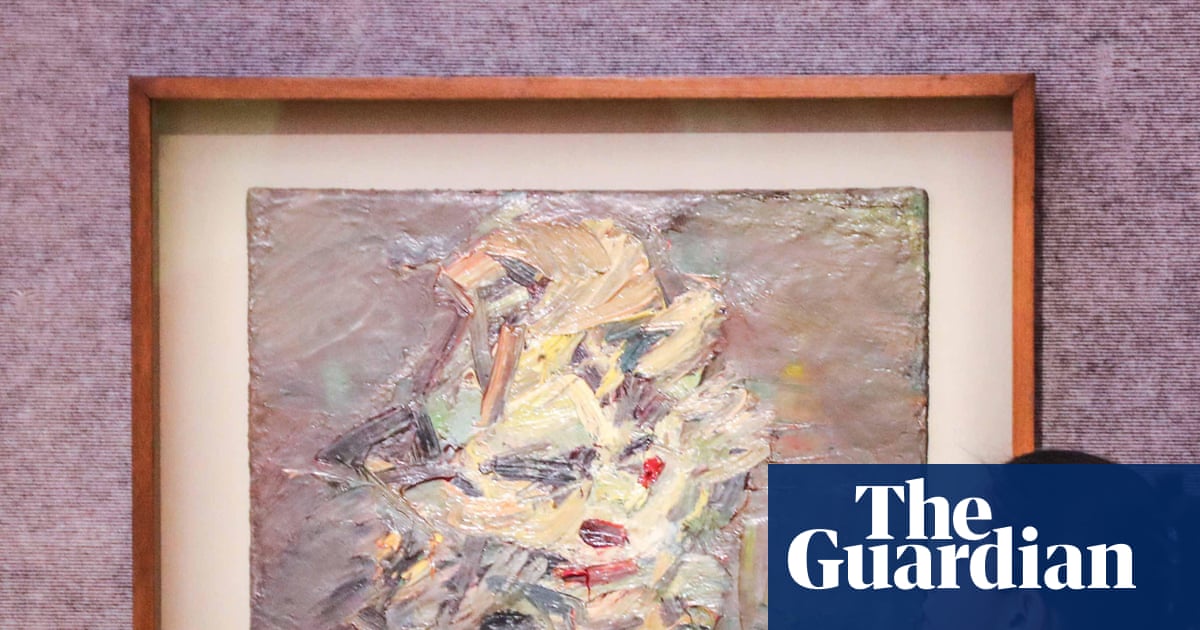

In November of last year, British artist Euan Uglow’s painting titled “Potiphar’s Wife” was featured in a private sale at Christie’s in London. Art historian and curator Catherine Lampert expressed her excitement about the discovery, stating, “We were all so thrilled. I had tried repeatedly to trace the whereabouts of that piece.” The artwork portrays a woman reclining on the floor against a blue wall, with her legs crossed and arms extended behind her, seemingly attempting to prevent a man in a T-shirt from departing. Both figures are connected by a gracefully arranged piece of orange fabric.
This particular painting was the last subject of discussion between Uglow and Lampert before his passing from cancer in August 2000. Lampert, who had known Uglow since her early 20s and organized his first major exhibition in 1974, was engaged in compiling the catalogue raisonné of his work—an exhaustive annotated catalog of his paintings—during his final months.
“Euan had a somewhat enigmatic demeanor,” Lampert recalled. “However, in his last months, he allowed me to document our conversations for this book, and then he would assertively clarify, ‘This is what this painting represents.’ On my last visit to him in the hospital, he urged me, ‘Let’s get to work.’” Although that day only yielded a few minutes of recorded dialogue, Lampert cherished the insights she gained, such as the description of a vertical yellow band that stabilizes the composition as being “satiny and still,” along with the dynamic quality of the drapery.
Sitting at an old square table that has been part of her London home for five decades, Lampert reflects on the many influential individuals who have gathered around it, including artists like Uglow and Frank Auerbach. The art and photographs adorning her walls signify her prominent role in contemporary art.
In the past year, Lampert has co-authored a catalogue raisonné for Lucian Freud’s paintings, curated a retrospective for Auerbach, contributed essays for Hurvin Anderson’s recent exhibition in New York as well as Freud’s current display at the National Portrait Gallery, and last week, she inaugurated “Euan Uglow: An Arc from the Eye” at MK Gallery in Milton Keynes, marking the artist’s first significant exhibition in two decades.
For someone nearing 80, Lampert’s workload is impressive. “Indeed,” she acknowledges, “I never seem to want to stop working. The thought of art—both creating and observing it—keeps me endlessly engaged.”
Born in Washington, D.C. in 1946, Lampert moved to London as an exchange student at the age of 20 to study sculpture at the Slade School of Fine Art. She preferred to forge her own path. “I didn’t want to be a part of Reg Butler’s class,” she explains, referring to the head of the sculpture department at the time. “I didn’t connect with that environment. Instead, I would go to Camden Art Centre, where a notable Sudanese potter named Mohammed Abdalla allowed people to freely use the clay.”
Over the years, she cultivated numerous connections. After completing her postgraduate studies in the U.S. and Rome, she worked with the Arts Council, then at the Hayward Gallery, and from 1988, served as the director of the Whitechapel Gallery in London, departing in 2001 when the gallery celebrated its centenary.
“I have been tenacious,” she states, “and I have advocated strongly.” Lampert recounts how she persuaded Freud to encourage Norman Rosenthal, the head of exhibitions, to feature Auerbach at the Royal Academy after a long period of neglect. Similarly, she curated a 2019 exhibition showcasing Paula Rego’s paintings at MK Gallery, a time when there was little interest in her work. Following this, Rego’s popularity surged, and Uglow may be on the brink of a similar resurgence.
Lampert holds the record for the longest sitting with Auerbach, second only to his wife, participating in weekly two-hour sessions from 1978 until his passing in November 2024. “It has profoundly shaped my life over 46 years. The privilege of being in his studio and experiencing his work has been transformative and emotionally impactful.”
In 2013, while preparing for the Daumier exhibition at the Royal Academy, she visited Berlin. “I asked Frank about his former residence, and he provided me with the address. I was the first person to visit that location and see the Stolperstein—a small concrete cube with a brass plaque honoring Holocaust victims,” she shared, noting that Auerbach’s parents were murdered at Auschwitz after he escaped to Britain at the age of eight.
“If you take the time to engage deeply rather than rushing for a story, these small details become significant,” Lampert observes. “You can envision Frank in that courtyard. Your emotional connection to artists transforms them from mere professional contacts into something much more meaningful. I don’t imply an intimate relationship; rather, it’s about a profound sense of care.”
She retrieves a framed photograph from Auerbach’s 93rd birthday celebration in April 2024. “He was feeling quite uncomfortable that day, so I offered him a shoulder massage. Jeremy King, the founder of The Wolseley, looked taken aback, as if to question my actions. But I sensed it was what he needed; he was in a fragile state.”
“I truly miss him,” Lampert admits. “Adjusting to his absence is challenging. I long for his voice and the rhythm of our interactions.” Following his death, she dedicated several months to documenting the books in his studio, carefully recording the images and details they contained.