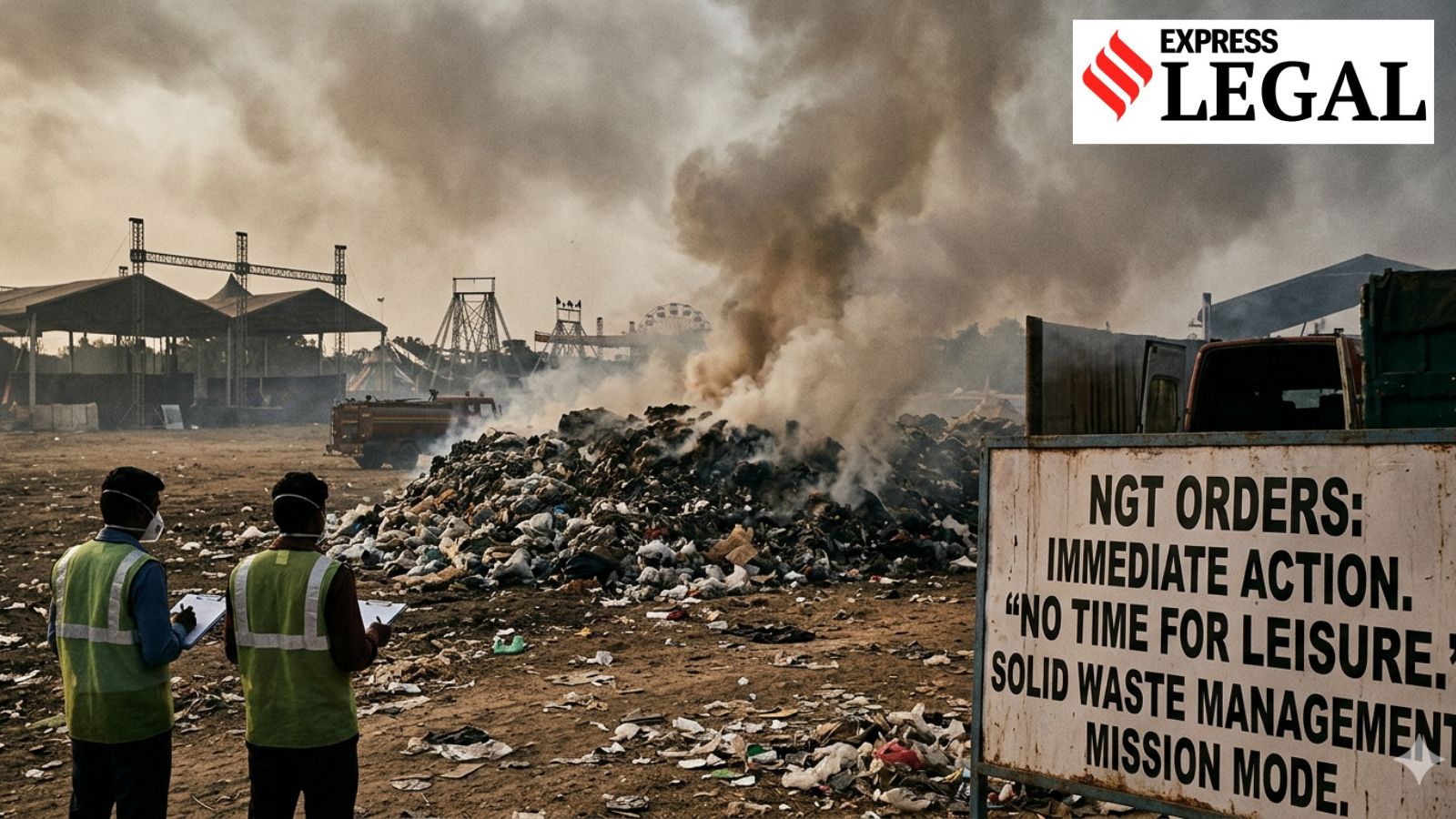

The National Green Tribunal (NGT) has emphasized the urgency of addressing India’s escalating waste management crisis, stating that “there is no time for leisure.” The tribunal has advocated for a comprehensive and immediate reform of waste management practices, cautioning that ongoing delays, insufficient accountability, and disjointed governance are jeopardizing public health and harming the environment.
This announcement came during a hearing involving a petition by Prabhat Pandey, who raised concerns about the illegal open incineration of municipal solid waste at the BHEL (Bharat Heavy Electricals Limited) Dussehra Ground. This incident followed the Bhopal Utsav Mela and reportedly resulted in hazardous air quality, with an Air Quality Index (AQI) of 315, violating several environmental regulations.
The NGT, represented by Justice Sheo Kumar Singh and Dr. Prashant Gargava, criticized the reliance on distant compliance deadlines, which have historically gone unheeded without accountability. They argued that such an approach is inadequate and fails to acknowledge the urgent need for immediate corrective action. “Long-term deadlines that have been repeatedly disregarded are not a viable solution. This pattern suggests a lack of awareness regarding the serious situation that demands urgent intervention,” the NGT remarked on April 10.
Vineet Upadhyay, an Assistant Editor at The Indian Express, specializes in the coverage of the Indian judicial system. With extensive experience in legal journalism, he focuses on clarifying complex court judgments from the Supreme Court and various High Courts, as well as District Courts. His reporting encompasses a broad range of legal topics, including:
- Constitutional and Civil Rights: Coverage of significant decisions related to privacy, equality, and governmental accountability.
- Criminal Justice and Enforcement: In-depth reporting on notable cases involving the Enforcement Directorate, NIA, and POCSO legislation.
- Consumer Rights and Environmental Law: Insightful articles on compensation for medical negligence, environmental advocacy (such as recognizing rivers as “living entities”), and labor rights.
With over ten years of professional experience, Upadhyay previously worked as a Principal Correspondent and Legal Reporter for The Times of India and held key positions at The New Indian Express, reporting from important legal centers such as Delhi and Uttarakhand.