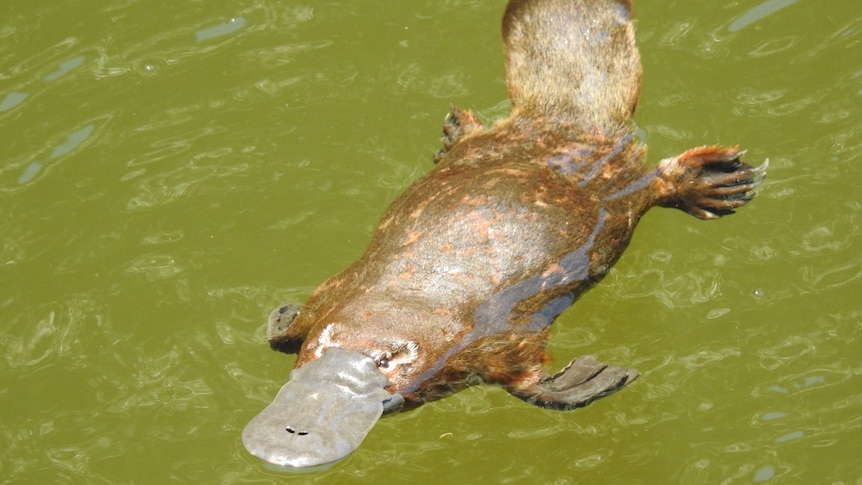

Recent sightings of platypuses in Queensland’s Pioneer Valley have generated curiosity regarding the movement patterns of this unique species.
Experts are raising concerns about a decrease in platypus populations in southeastern Queensland, suggesting that this decline may extend statewide. Conservation advocates are urging for a comprehensive assessment of platypus numbers to facilitate a “vulnerable” status on the national conservation list.
Jessica McDonald had initially mistaken what she thought was a rat darting across the road while she was picking up a friend from a pub in northern Queensland. However, upon closer inspection, she realized it was actually a platypus.
Quick to react, McDonald recorded video footage of the platypus as it hurried alongside the roadside near the Pioneer River in Marian, located west of Mackay. “He was incredibly fast,” McDonald remarked. “I had no idea they could move that quickly.” She expressed her astonishment at finding the platypus more than half a kilometer away from the riverbanks, contemplating the idea of picking it up but ultimately deciding against it due to the male platypus’s venomous spur.
According to Tamielle Brunt from Wildlife Queensland, it is generally advisable to leave these native creatures undisturbed, noting that encounters with platypuses near their habitats are becoming more frequent. Dr. Brunt, who spoke on the elusive nature of platypuses, mentioned that while sightings are not rare in the area, the Broken River at Eungella to the west is often regarded as a prime location for observing them in their natural environment.
Dr. Brunt explained that male platypuses can wander considerable distances from their burrows, sometimes exceeding 20 kilometers. “They are naturally inquisitive,” she added. However, she pointed out that factors such as urban development in Marian may be pushing them further from their natural waterways. “Increased pollutants and the proximity to urban areas can lead to heightened erosion and habitat destruction,” she explained.
A comparison between historical sighting records and a recent population survey in southeastern Queensland has revealed a significant decline in platypus numbers, a trend Dr. Brunt hopes to avoid in northern Queensland. She is advocating for platypuses to be classified as “vulnerable” under the national Environment Protection and Biodiversity Conservation (EPBC) Act, as they are currently not recognized as officially threatened.
Dr. Brunt noted that an application made in 2020 for this classification was denied, partly due to the challenges in accurately counting these elusive animals. “Even when we trap and tag them, it’s impossible to confirm if we are capturing every individual in the ecosystem,” she remarked.
Alison Pighills, treasurer of Fauna Rescue Whitsundays, mentioned that while sightings seem to be on the rise, she has responded to two calls for platypus rescues in Marian this year. Her first experience involved assessing a platypus for potential road injuries, which turned out to be unharmed. In another instance, she was alerted to a platypus struggling near a drain, but the animal had vanished by the time she arrived.
Dr. Brunt cautioned that while an increase in sightings might suggest a growing population, such anecdotal evidence could potentially obscure a more significant decline in numbers. “In communities across southeastern Queensland, we are beginning to hear that people are not spotting them as frequently,” she noted. “We are facing a shifting baseline, and we are striving to collect data that will demonstrate to the government the necessity of proactive measures.”